
Anatomy of a Misunderstood Artist
- Theartist Henley
- Apr 30
- 4 min read
Updated: May 1

There is a particular artist who few today probably know or think of as well-known, and I've mentioned him before. William Blake is that artist, and I felt compelled to talk about him now. There are quite a few artists of the past that I feel I identify with: Van Gogh, Dalí, Edvard Munch, and maybe a few more. But at this stage in my life, William Blake is one I feel I identify with most.
Like him, my work has gone largely unappreciated (so far) in my lifetime.

Not to make this about myself, I do recognize that Blake's art has significantly impacted my work. In his day, he was seen as a mystic and eccentric, and, unfortunately, it's common for creative and innovative minds to be underappreciated in their own time.
As I look at and study his art today, I find it hard to believe that anyone would fail to recognize his creative genius.
William Blake, born in London on November 28, 1757, often experienced visions of heavenly worlds that deeply inspired his writing, poetry, and art. He created a rich mythological universe from these visions. His wife, Catherine Boucher, who couldn't read or write at first, learned with his help and became a crucial partner in his projects, assisting him with his work.

Blake's cosmic themes have intrigued me since I first viewed them during my youth. Some old school Bibles that contain artwork in their pages have displayed Blake's Ancient of Days, taken from the book of Daniel 7:9:
As I looked, thrones were placed, and the Ancient of Days took his seat; his clothing was white as snow, and the hair of his head like pure wool; his throne was fiery flame and its wheels burning fire.
Yet, instead of illustrating Yahweh or Jehovah, as some have assumed, the watercolor etching actually portrays Urizen, a character from Blake's unique cosmology, symbolizing the embodiment of reason and law.
Much of Blake's work has fiery symbolism, a feature which is prominent in my own work.
Consider my piece Sun Eater.
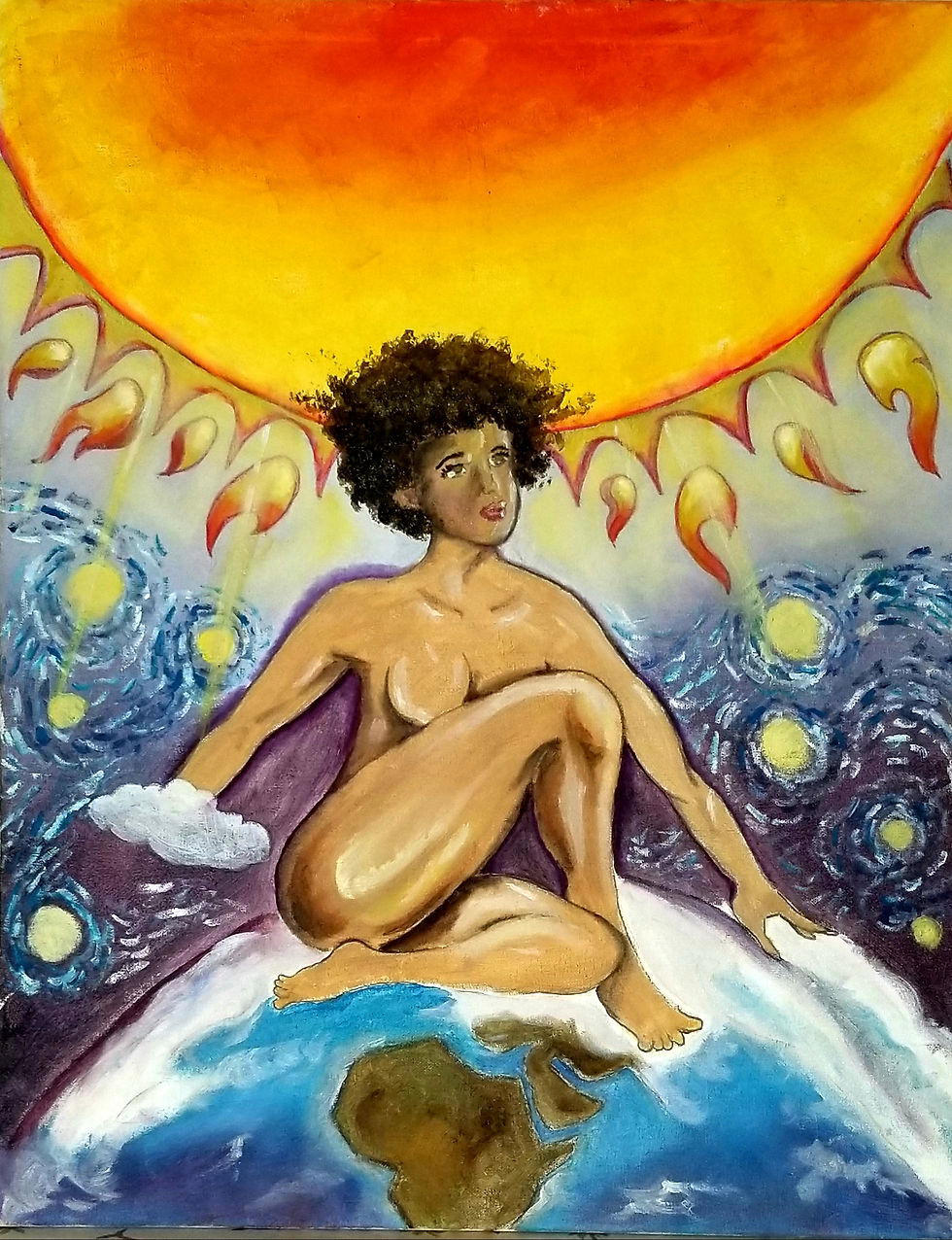
I know what the painting means to me, but I'm one of those artists who doesn't like to paint and tell, so to speak; I prefer to let the viewer find their own meaning.
Another painting of mine, A Fire Burns, is a little more explanatory; it has an accompanying poem of the same title, which can be found here.
,

The intense, heavenly symbolism in my artwork reaches its peak in my personal favorite, The Creation of Eve. Although the title might appear straightforward, I choose not to explain what the cosmic symbolism signifies to me; again, you'll need to interpret it yourself.

If you look closely, though, you can see some of Blake's influence on my own art. Note the position of the male figure on my Creation, and then
check out the posture of this figure below, Blake's Nebuchadnezzar.

Here, Nebuchadnezzar is referenced in Daniel 4:33, where he lost his sanity for seven years:
At that moment the word was fulfilled on Neb·u·chad·nezʹzar. He was driven away from mankind, and he began to eat vegetation just like bulls, and his body became wet with the dew of the heavens, until his hair grew long just like eagles’ feathers and his nails were like birds’ claws.
I keep coming back to the tension in William Blake’s work—how full it is of religious symbolism, even though he was openly critical of organized religion. It doesn’t really feel like a contradiction. If anything, it feels intentional. Blake wasn’t rejecting the spiritual side of things; he was pushing back against the idea that it had to be controlled or defined by institutions. So he built something of his own—a whole mythological world with figures like Urizen, Los, and Ahania. Not as an escape, but as another way of seeing.
That idea has been sticking with me. I’ve been told more than once that I should think about building a more connected universe around my own work—something that ties together pieces like Sun Eater, Gaea’s Symphony, Creation of Eve, and others. I’m not entirely sure what that would look like yet, but it doesn’t feel like a stretch either. Those pieces already seem to be in conversation with each other, whether I’ve fully defined it or not.
I’ll admit there are times when it gets frustrating—when the work feels overlooked, or at least not really engaged with. But the more I sit with it, the more I think recognition might not be the point. The work keeps going for a different reason: a real love for the process, for the act of making something and following it until it starts to reveal more than you expected. Blake, who wasn’t exactly celebrated in his lifetime, probably understood that better than most. And maybe that’s the real connection—not in style or subject, but in the simple need to keep creating, whether anyone’s paying attention or not.


Comments